You must evaluate a SaaS management platform by what it can find, understand, act on, and prove. Our requirement checklist is built around the seven pains that cost enterprises money every day.
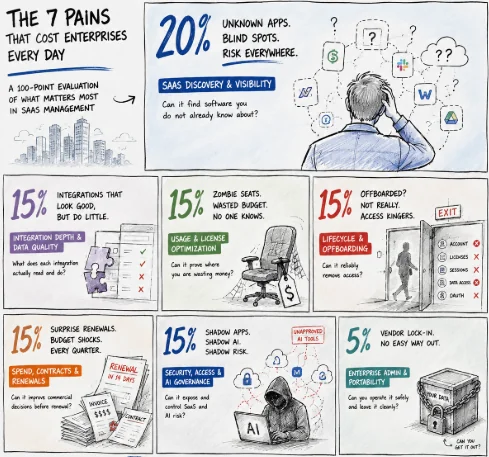
Discovery gets the highest weight because you cannot manage software you cannot see. IT admins typically estimate 30–40 cloud apps are in use; actual usage averages 1,000+. Microsoft reports that 80% of employees use unsanctioned applications.
SSO is a useful starting point, but employees still buy subscriptions on corporate cards, expense tools personally, create accounts that never touch the identity provider, and authorize OAuth applications outside any of it.
A shallow connector may only show who has an account. A deeper integration tells you what license they have, how they use it, and what access they hold. The best integrations go one step further: they let you take action — suspend accounts, reclaim licenses, change plans.
This distinction matters because information quality and system quality have long been treated as separate, core dimensions of whether an information system is actually useful.
Current FinOps guidance for SaaS licensing now recommends measures such as active-to-provisioned users, license-utilization rates, and SaaS unit cost — rather than simply counting purchased seats. Community forums have a name for what gets missed without this: "zombie SaaS seats."
Offboarding has to cover the identity provider and individual SaaS accounts, files, ownership, and exceptions — not just the single-sign-on layer.
FinOps now treats SaaS renewal dates, commitments, and overage terms as connected management data. Preparing for a major renewal with complete usage and entitlement data in hand is considered standard practice now — though admins on Reddit often describe a messier reality.
SaaS management in 2026 has to include OAuth applications, privileged users, unmanaged SaaS, personal AI accounts, embedded AI features, AI agents, and any service that may process company data. Simply asking whether a vendor has SOC 2 is no longer enough.
Shadow AI use nearly doubled — from 8.9% to 17.9% — once employees understood the benefits of using AI tools while expecting little penalty for not disclosing it.
Your SaaS management platform may eventually hold years of contracts, spend, and audit history. Granular admin permissions are a must — and so is a clean way to retrieve that information if you ever leave.
You don't need to estimate your SaaS ROI from someone else's benchmark. Connect your data to Nicklpass and see your software spend, usage, projected costs, and biggest spending drivers in your own environment.
